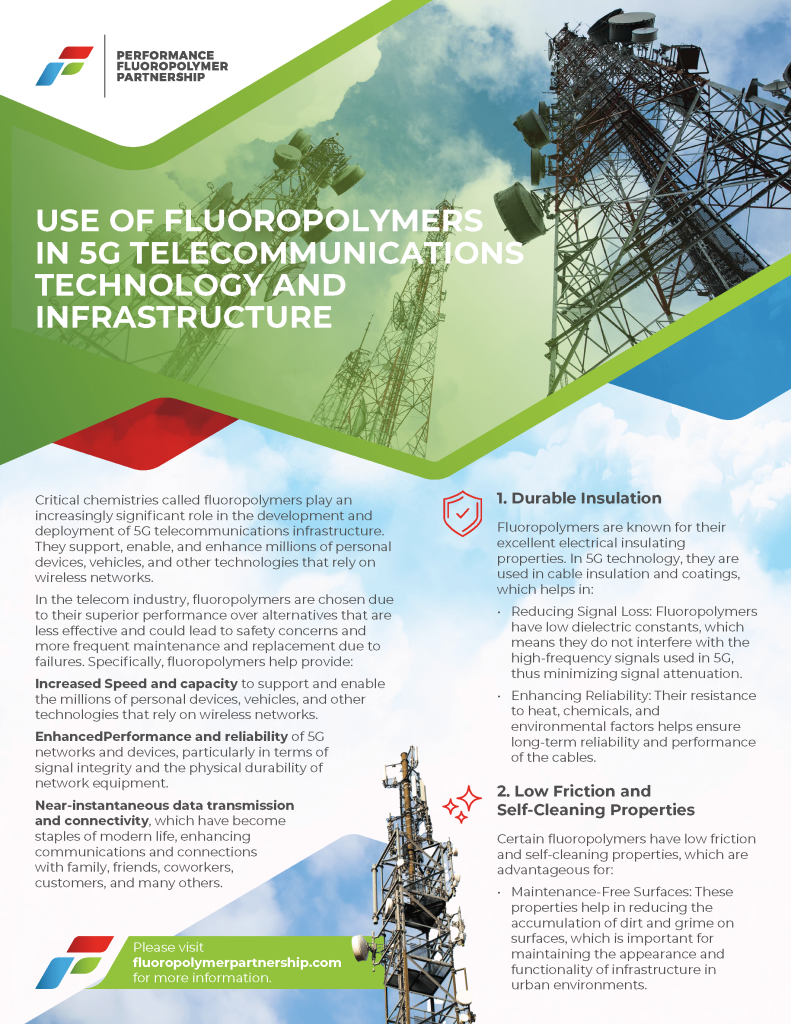
Full-color infographic available here.
Critical chemistries called fluoropolymers play an increasingly significant role in the development and deployment of 5G telecommunications infrastructure. They support, enable, and enhance millions of personal devices, vehicles, and other technologies that rely on wireless networks.
In the telecom industry, fluoropolymers are chosen due to their superior performance over alternatives that are less effective and could lead to safety concerns and more frequent maintenance and replacement due to failures.
Specifically, fluoropolymers help provide:
Increased speed and capacity to support and enable the millions of personal devices, vehicles, and other technologies that rely on wireless networks.
Enhanced performance and reliability of 5G networks and devices, particularly in terms of signal integrity and the physical durability of network equipment.
Near-instantaneous data transmission and connectivity, which have become staples of modern life, enhancing communications and connections with family, friends, coworkers, customers, and many others.

Durable Insulation
Fluoropolymers are known for their excellent electrical insulating properties. In 5G technology, they are used in cable insulation and coatings, which helps in:
- Reducing Signal Loss: Fluoropolymers have low dielectric constants, which means they do not interfere with the high-frequency signals used in 5G, thus minimizing signal attenuation.
- Enhancing Reliability: Their resistance to heat, chemicals, and environmental factors helps ensure long-term reliability and performance of the cables.
Low Friction and Self-Cleaning Properties
Certain fluoropolymers have low friction and self-cleaning properties, which are advantageous for:
- Maintenance-Free Surfaces: These properties help in reducing the accumulation of dirt and grime on surfaces, which is important for maintaining the appearance and functionality of infrastructure in urban environments.
High-Temperature Resistance
5G infrastructure often operates in varying environmental conditions, including high temperatures. Fluoropolymers can withstand extreme temperatures reducing the risk to degradation, making them suitable for:
- Protective Coatings: These polymers are used as protective coatings for electronic components and cables to help prevent damage from heat and environmental factors.
- Cooling Systems: They are also used in the cooling systems of 5G equipment, as they maintain their properties even at elevated temperatures.
Chemical Resistance
Fluoropolymers are highly resistant to chemicals, which is beneficial for:
- Outdoor Installations: For components exposed to pollutants, corrosive substances, or harsh weather conditions, fluoropolymers provide critical protection.
- Maintenance: They reduce the need for frequent maintenance or replacement of components exposed to aggressive environments.
Flexible Applications
Fluoropolymers offer flexibility and can be used in various forms, such as films, coatings, and encapsulants. This versatility allows them to be incorporated into a range of smart city applications, including:
- Flexible Electronics: For innovative smart devices and sensors embedded throughout the city.
- Wearable Technology: Increasing durability and reliability in wearables that may be used for monitoring and managing urban infrastructure.
High Frequency Performance
Fluoropolymers are used in high-frequency applications due to their:
- Stable Electrical Properties: They help ensure stable performance of high-frequency signals, which is critical for the rapid data transmission required by 5G networks.
- Reduced Interference: Their dielectric properties help in reducing electromagnetic interference, which improves signal clarity and reliability.
Fluoropolymers enhance the performance, durability, and reliability of 5G infrastructure and technologies. Their unique combinations of properties support the development of advanced communication systems and networks, helping to create more efficient and connected communities.